IndoorNav
IndoorNav aims to design a navigation aid to help vulnerable people find their way around complex buildings (hospitals, universities, shopping malls, etc.).
Getting around in complex built environments (such as hospitals or shopping malls) is often a major challenge for the visually impaired, whether because of the obstacles in their way (doors, steps), the lack of guidance information (absence of signage) or the lack of legibility of the information available. At present, although applications such as Google Maps seek to integrate information on certain buildings, this is often patchy, and the paths that are proposed do not take into account the diversity of users of these places. What's more, GPS-based positioning systems often lack precision in built-up environments, severely limiting their usability. The IndoorNav project is working to develop a solution to these issues.
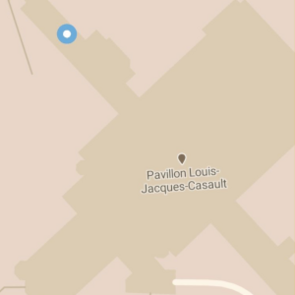
By combining GPS signals with the use of Bluetooth beacons placed at strategic points in complex buildings, the IndoorNav project makes it possible to fine-tune positioning inside buildings and easily identify which floor a user is on (as opposed to GPS signals alone, which cannot identify the floor). This makes it easier to guide people precisely. The project also aims to precisely map and model the interior of buildings to enable precise route calculation based on the user's profile. An application is currently being developed and tested at Université Laval's Casault Pavilion, in collaboration with several industrial partners.